The room is dark.
A screen flickers.
You are here, in your seat. Or elsewhere, behind glass, behind a headset.
The performance has already begun.
To speak of live hybridity in the current climate of performance-making is to confront the difficulty of narrating an event that is always more than itself. The live encounter is neither reducible to the physical presence of bodies in space, nor to the mediated frames of digital technologies through which it is increasingly extended. Instead, hybridity gestures towards a dramaturgical field in which the live is constituted through interaction, negotiation, and the continual re-mapping of forces across multiple registers: the narrative, the embodied, the technological, and the socio-political. Live Hybridity may thus be understood as a form of performance where story, liveness, and technology are interwoven from the outset, created equally for audiences in the room and those online. Whether through livestream, XR, VR, AR, or the metaverse. Its distinctive quality lies in the creative tensions or frictions designed between audiences, performers, and technologies, tensions which sharpen perception and cultivate a meaningful experience.
The notion of mapping offers one possible entry point into this complexity. To map is not merely to chart a territory but to compose a story of relations. In live hybrid performance, mapping becomes dramaturgical practice: a way of tracing the dynamic entanglements between performer, audience, and technology. Such a map is not fixed; it is responsive, adaptive, and alive to the contingencies of the event. It acknowledges that the dramaturgy of hybridity cannot be reduced to a singular storyline, but must instead unfold as a cartography of connections, ruptures, and resonances. This cartographic sensibility resists abstraction for its own sake. Rather, it grounds itself in the authentic narrative needs of the work: the story-line must be at once concrete and abstract, anchored in specificity while also capable of traversing temporal and spatial registers. Authenticity here does not denote a return to some pre-technological purity, but the capacity of performance to remain faithful to its own process of becoming. Mapping, therefore, becomes an ethical gesture: a way of attending to how stories are told, embodied, mediated, and shared across the physical and digital dimensions of the stage.
I say:
“Imagine it!”
“Layer it.”
“Map it”
“Connect it”
“Translate it”
“Embody it”.
“Phygital.”
Morphs one scene into another without warning.
Wearing a mask:
“Walk the live hybrid as though it were a building. Choose your own path, or have the courage to create your own path”
If live hybridity requires mapping, it also requires an expanded sense of narrative. Storytelling in live hybrid performance cannot be conceived solely in linear terms; it must instead accommodate multiplicity, simultaneity, and interruption. The dramaturgy of live hybridity is one in which narrative threads proliferate across diverse media, requiring audiences to negotiate meaning within a field of interwoven signals. Here, the challenge for the maker is not to eliminate dissonance but to orchestrate it.
I say: allow narrative to operate as an assemblage of embodied gestures, projected images, algorithmic processes, and live speech. The story-line becomes not a singular plot but a networked composition, oscillating between the concrete and the abstract, between visceral presence and mediated extension.
Central to this dramaturgical mapping is the question of the body. In live hybrid practice, the body is neither diminished by technology nor entirely subsumed by it. Rather, the body becomes the site through which technological systems are negotiated, contested, and made perceptible. The needs of the body, for rhythm, breath, gesture, and affective exchange, persist across the hybrid environment, shaping the very conditions under which technology can operate within the performance.
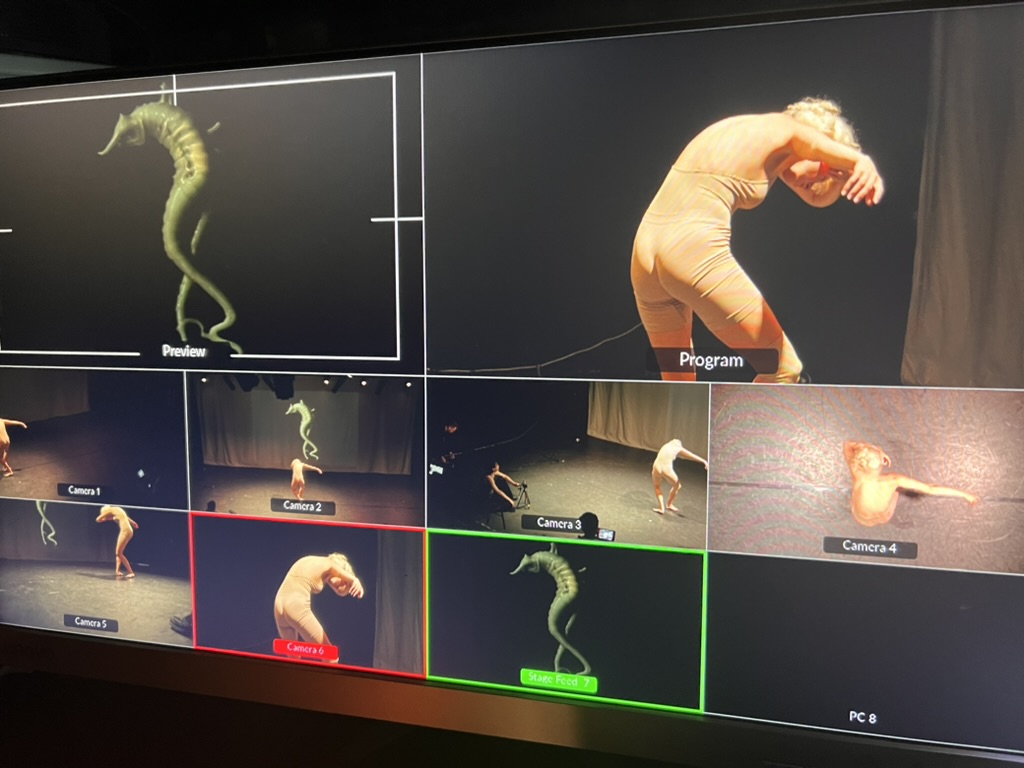
The body sweats in the physical space it breathes without latency, it watches you the spectator as you are watching it. Trembles. How do we see it, how does it extend itself into code. You see it, you don’t see it. It falters, then insists: “I am here.”
The live body insists upon its vulnerability, even within XR or digitally augmented environments. It sweats, trembles, falters, and yet it also adapts, extending itself through avatars, projections, sensors, and interfaces.
I say:
The dramaturgical task lies in articulating how this body can remain legible to audiences across the layered realities of physical and digital space. Hybridity, then, is not only a matter of technological innovation but of corporeal ethics: how does one safeguard the lived experience of the performer and the embodied recognition of the audience amidst the proliferations of mediation?
Extended reality (XR) provides a particularly fertile ground for this exploration. XR environments invite spectators to inhabit hybrid spaces where the boundaries between physical theatre and digital immersion are deliberately blurred. Yet the dramaturgy of XR must go beyond spectacle. To map the interactions between live body and digital environment is to ask: how can narrative remain perceptible, how can affect remain authentic, when the audience’s perceptual field is fragmented across headsets, projections, and shared space? The answer may lie in designing dramaturgies that foreground relationality. XR is not a neutral tool but a participant in the performance: it conditions how bodies move, how attention is distributed, and how presence is felt. In hybrid dramaturgy, the task is not simply to overlay digital content onto live action, but to compose meaningful interactions between the two, allowing each to transform the other.
I say we need to intuitively trust the multiconnections:
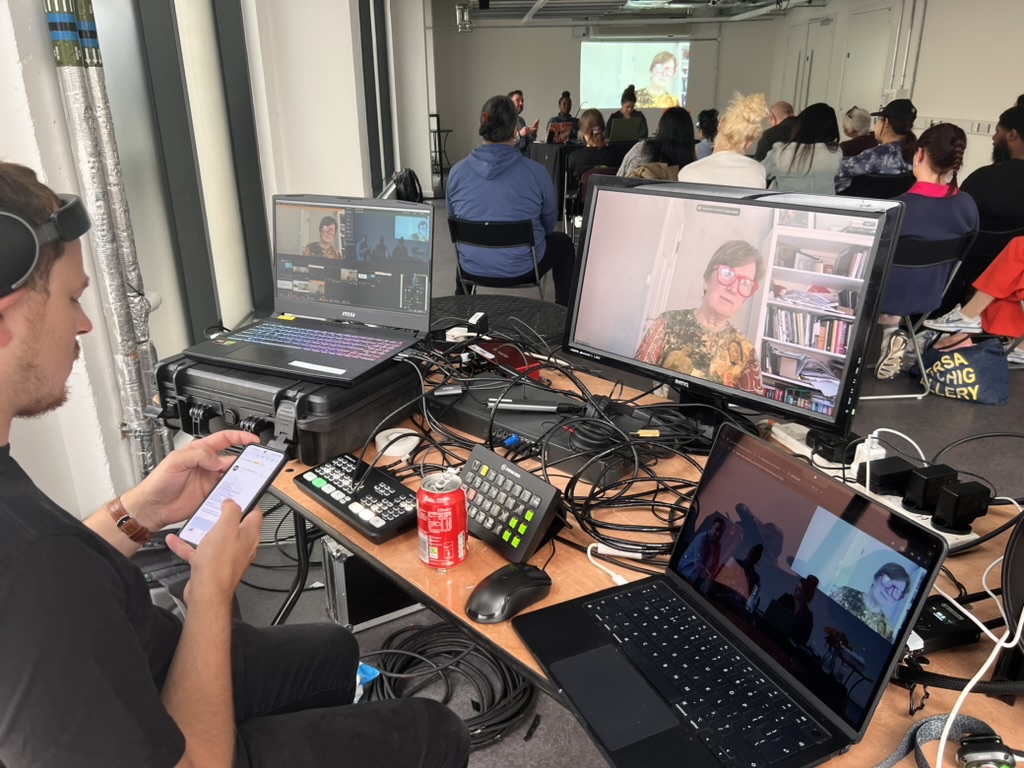
Cut. Dissolve. Fade in: the audience. Some are here. Some are elsewhere. Some arrive days later in fragments. All watching, not quite together. Yet presence sharpens in the distance.
A further complication emerges when considering the audience. I n live hybrid performance, the audience may be present in the theatre, attending via livestream, inhabiting XR environments, or experiencing fragments asynchronously through recordings and social media. To portray narrative authentically in such conditions requires acknowledging that the audience itself is hybrid, dispersed across spaces and temporalities. The dramaturgical challenge lies in crafting a performance that can resonate across these divergent modes of attendance. This does not mean replicating the same experience in every context—indeed, hybridity resists uniformity. Rather, it means composing layers of narrative and embodiment that can travel across formats while still retaining coherence. The live theatre event, in this sense, becomes both a situated gathering and a distributed network, demanding that performance-makers think in terms of multiplicity, translation, and resonance.
Equally crucial is the recognition that hybridity begins long before the performance itself: it is inscribed in the workflow, in the ways creative processes are organised, and in the infrastructures that sustain them. To construct hybridity authentically demands attention from the very inception of the work. The workflow cannot be treated as a neutral backdrop, for it actively shapes the dramaturgy of the piece. Decisions about rehearsal practices, the sequencing of physical and digital tasks, the integration of XR technologies, and the communication between interdisciplinary collaborators all feed directly into the aesthetic and performative outcomes.
Backstage: calendars pinned to walls, Gantt charts projected on screens, teams convened, dispersed, reconvened. Invisible choreography. Someone holds the rhythm, the pulse of delivery.
I ask, how can we elevate our creativity?
The mapping of workflow in live hybrid practice is, in fact, a specialised role in itself. Beyond the creative dramaturgy of the work, there is the pragmatic necessity of sequencing tasks, setting milestones, and ensuring that the right elements are delivered at the right time. This requires a practitioner who can hold the temporal logic of the project: someone who schedules rehearsals and technical build phases, who convenes interdisciplinary teams at crucial junctures, and who oversees the rhythm of the process from inception to performance. Such a role might be thought of as a hybrid performance project manager, a figure responsible for the operational dramaturgy of the work. Their task is not primarily aesthetic but structural: to construct the scaffolding of timelines, deadlines, and communications that allows the creative team to function fluidly. By managing the logic of delivery, they safeguard the conditions under which the artistic and technological strands can interweave productively. In this sense, project management itself becomes an art of care, a form of invisible choreography that underpins the emergence of live hybridity. A mindful workflow, then, becomes itself a kind of dramaturgy: a choreography of processes through which narrative, embodiment, and technology are developed in dialogue rather than in isolation. By attending to workflow, practitioners ensure that hybridity is not bolted on as an afterthought but woven into the DNA of the work, allowing the piece to emerge as a coherent cartography rather than a fragmented overlay. This attentiveness honours both the body and the technology, ensuring that the live event can sustain its complexity while remaining legible and affective to audiences across physical and digital domains.
At the core of this project lies a dialectic between the concrete and the abstract. The concrete emerges in the visceral gestures of the body, the tactile dimensions of space, the immediacy of shared presence. The abstract manifests in the algorithms that shape XR environments, the conceptual architectures of narrative, and the theoretical frames through which hybridity is articulated. A dramaturgy of hybridity must continually negotiate between these registers, ensuring that abstraction does not eclipse embodied experience, and that concreteness does not foreclose conceptual possibility. In this dialectic, the authenticity of the narrative is preserved not by clinging to purity but by embracing hybridity as a mode of fidelity to complexity. To craft a concrete–abstract narrative is to affirm that performance can be both affectively immediate and critically reflective, both locally situated and globally distributed.
The mapping of live hybridity is therefore not only an artistic or technical concern but also an ethical one. To compose across bodies and technologies is to take responsibility for the ways in which audiences are invited to participate, perceive, and imagine. It requires attentiveness to accessibility, to the politics of representation, and to the affective labour demanded of performers and spectators alike. In this respect, hybridity is not an end in itself but a method of inquiry: a way of probing how narratives are embodied, mediated, and experienced in an increasingly entangled world. The dramaturgy of hybridity resists closure, insisting instead upon openness, vulnerability, and the possibility of transformation.
The lights dim. The screen glows. A breath in the room. A signal online. The story continues. You are here. And elsewhere.
Live hybridity offers a fertile terrain for reimagining the possibilities of performance in an age of pervasive mediation. To write of hybridity is to engage in mapping: charting the dramaturgical interactions between narrative, embodiment, technology, and audience across physical and digital spaces. It is to recognise the body as a site of negotiation, XR as a dramaturgical participant, the workflow as an ecological system, the project manager as the guardian of temporal logic, and the audience as a dispersed yet interconnected assemblage. Ultimately, the task is to craft a narrative that is at once concrete and abstract, authentic in its fidelity to complexity, and porous enough to resonate across divergent modes of experience. Such a narrative does not resolve hybridity but inhabits it, offering performance as an open cartography of becoming, where live and mediated, physical and digital, concrete and abstract coalesce in the shared labour of imagining what it means to be present, together, now.